Framework for Medical Education in Mauritius
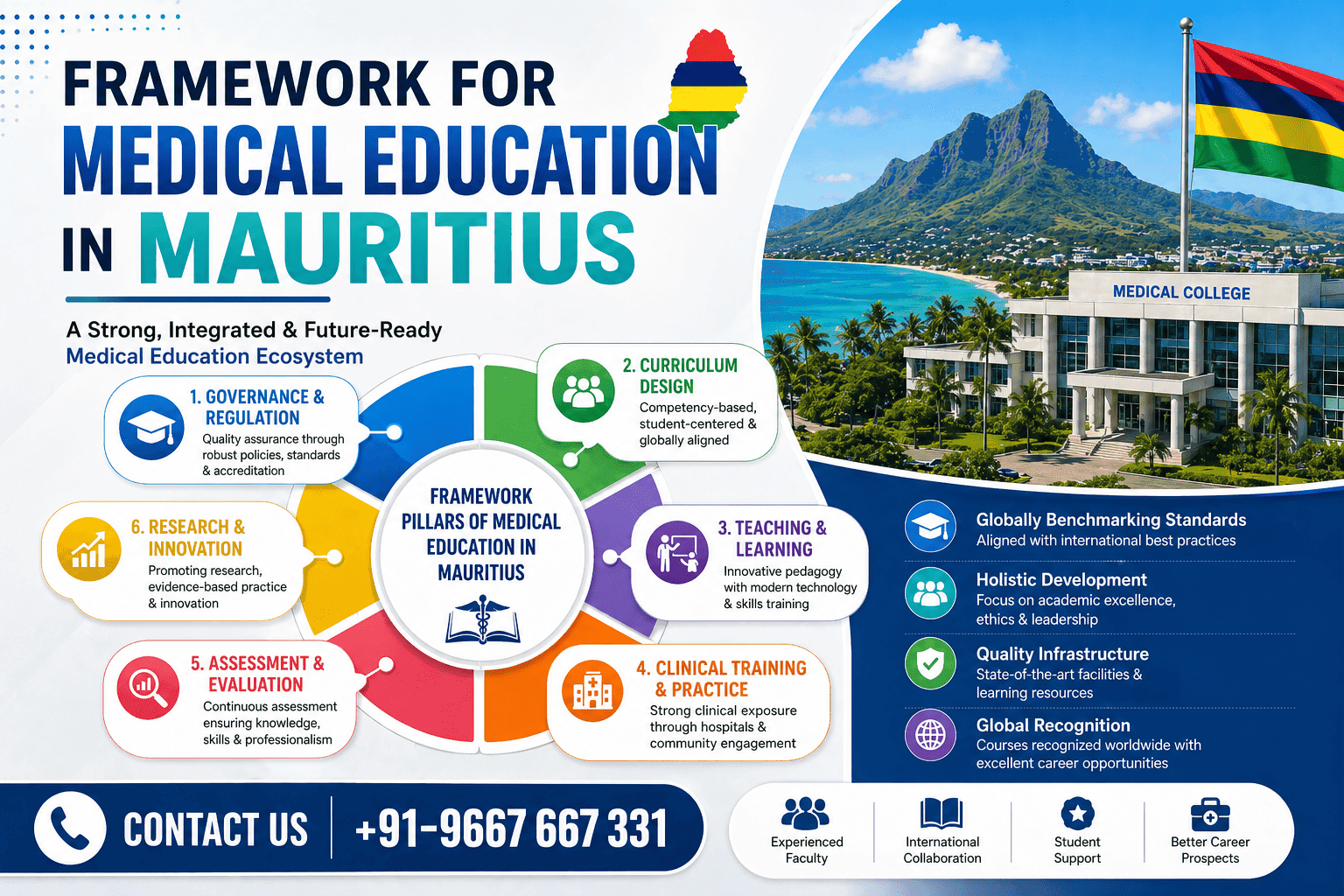
Medical education in Mauritius is regulated through a structured framework developed to maintain international standards in medical training. The Framework for Medical Education in Mauritius was approved by the Tertiary Education Commission (Mauritius) (TEC) on 31 July 2008.
This framework establishes the minimum requirements and regulatory guidelines that any medical college must follow in order to offer an MBBS (Bachelor of Medicine and Bachelor of Surgery) programme in Mauritius.
The framework ensures that medical institutions maintain high standards in terms of infrastructure, teaching faculty, laboratories, and clinical training facilities.
Introduction
Medical education in Mauritius is regulated through a structured framework developed to maintain international standards in medical training. The Framework for Medical Education in Mauritius was approved by the Tertiary Education Commission (Mauritius) (TEC) on 31 July 2008.
This framework establishes the minimum requirements and regulatory guidelines that any medical college must follow in order to offer an MBBS (Bachelor of Medicine and Bachelor of Surgery) programme in Mauritius.
The framework ensures that medical institutions maintain high standards in terms of infrastructure, teaching faculty, laboratories, and clinical training facilities.
Purpose of the Framework for Medical Education in Mauritius
The Framework for Medical Education in Mauritius serves as the foundation for building a strong, transparent, and globally recognized medical education system. As Mauritius continues to attract international students for MBBS and other medical programmes, this framework ensures that every institution follows strict academic, professional, and infrastructural standards. Its purpose is not only to regulate medical colleges but also to protect the quality of healthcare education and future medical professionals.
Creating a Strong Regulatory Environment
One of the primary objectives of the framework is to provide a well-defined regulatory environment for medical education in Mauritius. This means that all medical colleges and institutions must operate under clear legal and academic guidelines.
The framework helps regulate the following:
- Admission procedures
- Curriculum standards
- Faculty qualifications
- Examination systems
- Clinical training protocols
- Student welfare policies
By creating this structure, Mauritius ensures that all institutions maintain consistency and credibility in medical education.
Ensuring High-Quality Medical Training
A major goal of the framework is to maintain high-quality academic and clinical training standards. Medical education directly impacts the quality of future doctors and healthcare services, which makes quality control essential.
The framework focuses on:
- Modern medical curriculum
- Evidence-based learning
- Practical laboratory exposure
- Research-based education
- Clinical case studies
- Skill development
This ensures that students receive globally competitive education aligned with international medical standards.
Defining Infrastructure and Staffing Standards
The framework clearly outlines the minimum infrastructure and staffing requirements that every medical college in Mauritius must fullfill.
This includes:
- Smart classrooms
- Science and simulation laboratories
- Medical libraries
- Hostel facilities
- Research centers
- Qualified professors and specialists
- Administrative and support staff
These standards help create a professional learning environment that supports academic excellence.
Guidelines for Clinical Training in Teaching Hospitals
Clinical exposure is one of the most important parts of medical education. Therefore, the framework establishes clear guidelines for clinical training in teaching hospitals.
Medical colleges must ensure:
- Affiliation with approved teaching hospitals
- Adequate patient exposure
- Supervised hospital rotations
- Internship training
- Department-wise clinical postings
Which helps students gain hands-on practical experience in real healthcare settings.
Quality Assurance Through Accreditation
The framework also focuses on continuous quality assurance through regular accreditation and institutional reviews.
This includes:
Periodic inspections
Academic audits
Faculty assessments
Infrastructure checks
Compliance reviews
Such measures help maintain the long-term reputation and reliability of medical education in Mauritius.
Structure of the Framework
The framework is divided into two major components to ensure a balanced medical education system:
1. Non-Clinical Component
Focuses on academic foundation and institutional infrastructure
Ensures strong theoretical knowledge in early years of medical education
Includes:
- College Infrastructure & Facilities
- Well-equipped classrooms and lecture halls
- Libraries with digital and physical resources
- Student support and academic environment
- Teaching Laboratories & Equipment
- Advanced labs for Anatomy, Physiology, and Biochemistry
- Availability of modern instruments and practical tools
- Faculty Qualifications & Staffing Requirements
- Experienced and qualified teaching staff
- Proper teacher-student ratio for effective learning
- Continuous faculty development and training
- Academic Departments (Pre-Clinical & Para-Clinical)
- Dedicated departments for foundational subjects
- Structured curriculum for early-stage medical training
- Strong base before clinical exposure
All these standards are defined in Appendix A – Minimum Standards Requirements for a Medical College
2. Clinical Component
Focuses on practical, hospital-based medical training; Ensures real-world exposure and hands-on learning. Includes:
- Clinical Training Facilities
- Well-equipped teaching hospitals
- Access to modern medical technologies
- Hospital Infrastructure
- Functional wards, ICUs, operation theatres
- Emergency and outpatient services
- Patient Exposure & Clinical Teaching
- Interaction with diverse patient cases
- Real-time diagnosis and treatment learning
- Supervision by experienced doctors
- Clinical Departments & Specialties
- Medicine, Surgery, Pediatrics, Gynecology, etc.
Helps students develop practical skills, clinical knowledge, and professional competence
Minimum Standards for Medical Colleges
The framework clearly defines the minimum standards required for a medical college that admits 150 MBBS students annually, ensuring uniform quality in medical education and training. These standards are designed to maintain a balance between academic learning and practical exposure, which is essential for developing competent medical professionals.
Every medical college must have a fully equipped campus that includes modern classrooms, lecture halls, libraries, and student support facilities. This ensures a conducive learning environment for students throughout their academic journey. In addition, the presence of an associated teaching hospital is mandatory, as it plays a crucial role in providing hands-on clinical training and real-world medical exposure.
Another key requirement is the availability of qualified teaching staff. Experienced faculty members are essential for delivering quality education, guiding students, and maintaining academic excellence. Alongside this, well-developed laboratories and academic infrastructure are necessary for practical learning in subjects like Anatomy, Physiology, and Biochemistry.
Furthermore, the framework emphasizes the importance of clinical departments and patient care facilities. These ensure that students gain adequate exposure to various medical cases and develop essential clinical skills. Overall, these minimum standards help create a strong foundation for producing skilled and competent doctors.
Mandatory Departments in a Medical College
To ensure comprehensive medical education and high-quality training, every medical college offering an MBBS programme in Mauritius must establish a structured set of departments. These departments are broadly divided into pre-clinical, para-clinical, and clinical categories, each playing a vital role in shaping competent medical professionals.
Pre-Clinical Departments
Pre-clinical departments form the foundation of medical education, focusing on basic sciences that help students understand the human body and its functions. These include Human Anatomy, which deals with the structure of the body; Human Physiology (including Biophysics), which explains how the body functions; and Biochemistry, which focuses on the chemical processes within the body. These departments provide essential theoretical knowledge that prepares students for advanced clinical learning.
Para-Clinical Departments
Para-clinical departments act as a bridge between basic sciences and clinical practice. They help students understand diseases, their causes, and treatment approaches. Key departments include Pathology (including Blood Bank), which studies disease processes; Microbiology, which focuses on microorganisms and infections; and Pharmacology, which deals with drugs and their effects. Additionally, Forensic Medicine including Toxicology helps in legal aspects of medicine, while Community Medicine focuses on public health and preventive care.
Clinical Departments
Clinical departments are essential for hands-on training and real patient interaction. These include major specialties such as General Medicine, General Surgery, and Obstetrics and Gynaecology, along with specialized fields like Paediatrics, Psychiatry, Dermatology, Venereology and HIV/AIDS, and Chest Diseases and Tuberculosis. Other important departments include Orthopaedics, Radio-Diagnosis, Radiotherapy, Otorhinolaryngology (ENT), and Ophthalmology.
Infrastructure and Equipment Requirements
To maintain high standards in medical education, every department within a medical college must be supported by robust infrastructure and modern teaching facilities. These requirements ensure that students gain both strong theoretical knowledge and effective practical training in a structured learning environment.
Teaching & Learning Spaces
Medical colleges must provide spacious, well-ventilated lecture halls and seminar rooms equipped with modern audio-visual teaching aids. These spaces are essential for lectures, group discussions, academic presentations, and interactive learning sessions.
Demonstration Laboratories
Demonstration laboratories are a core component of medical training. Each laboratory should be equipped with advanced instruments and tools that allow students to conduct experiments and develop hands-on understanding of medical concepts.
Departmental Offices
Every department must have dedicated offices to support academic planning and administrative functions. These offices ensure smooth coordination between faculty, staff, and students, contributing to efficient departmental operations.
Medical Teaching Equipment
Adequate availability of medical teaching equipment is essential. This includes anatomical models, diagnostic instruments, laboratory equipment, and simulation devices that enhance clinical and practical learning experiences.
Technical Staff Support
Qualified technical and support staff play a vital role in medical education. Their responsibilities include maintaining equipment, assisting during laboratory sessions, and ensuring uninterrupted functionality of teaching resources.
Equipment Disclosure & Compliance
At the time of application, every medical college must submit a comprehensive inventory of equipment and laboratory facilities to the regulatory authority. This ensures transparency and confirms compliance with prescribed educational standards before approval.
Qualification Requirements for Medical Teachers
To ensure high-quality medical education, strict qualification standards are set for all medical faculty members. These requirements ensure that students are taught by competent, experienced, and professionally qualified educators.
All medical teachers must hold recognized medical university qualifications from accredited institutions, ensuring a strong academic foundation and subject credibility.
In addition, faculty members are required to have postgraduate specialization in their respective disciplines, enabling in-depth subject knowledge and effective clinical and theoretical instruction.
Where applicable, medical teachers must also be registered with the Medical Council of Mauritius, confirming legal authorization to practice and adherence to professional and ethical standards.
These qualification requirements are essential for maintaining academic excellence, enhancing student learning outcomes, and preparing future doctors to meet global healthcare standards.
Quality Assurance in Medical Education
Quality assurance is a vital component of medical education, ensuring consistently high standards in teaching, training, and academic delivery. The framework followed in Mauritius is designed to uphold excellence while aligning with international best practices.
A key objective of this framework is to maintain high academic standards across medical institutions through a structured curriculum, qualified faculty, and effective teaching methods. Regular evaluations and assessments ensure students achieve required competencies at every stage of their training.
Strong emphasis is placed on clinical training, providing students with hands-on experience in teaching hospitals. This exposure helps students develop practical skills, clinical confidence, and the ability to manage real-world healthcare situations.
The framework also promotes adherence to globally recognized medical education standards, ensuring that degrees awarded in Mauritius are internationally accepted and valued.
Continuous monitoring and accreditation by regulatory authorities ensure institutional compliance, quality improvement, and accountability. Regular inspections help maintain consistency and identify areas for enhancement.
Through this comprehensive quality assurance system, Mauritius delivers high-quality medical education and prepares competent, skilled, and globally competitive healthcare professionals.
Frequently Asked Questions
What is the Framework for Medical Education in Mauritius?+
It is a regulatory system approved by the Tertiary Education Commission (Mauritius) (TEC) on 31 July 2008 that sets minimum standards and guidelines for MBBS programs in Mauritius.
What is the main purpose of this framework?+
The framework ensures high-quality medical education by regulating academic standards, infrastructure, faculty qualifications, and clinical training across all medical institutions.
Who regulates medical education in Mauritius?+
Medical education is regulated by the Tertiary Education Commission (TEC), along with other relevant medical authorities.
What aspects of medical education does the framework cover?+
It covers admissions, curriculum design, faculty qualifications, infrastructure, examinations, clinical training, and student welfare policies.
How does the framework ensure quality in medical education?+
Through regular inspections, academic audits, faculty assessments, infrastructure checks, and compliance reviews to maintain consistent standards.
What are the two main components of the framework?+
The framework is divided into: Non-Clinical Component (academic foundation and infrastructure) Clinical Component (hospital-based training and practical exposure)
What is included in the non-clinical component?+
It includes infrastructure, laboratories, faculty qualifications, academic departments, and pre-clinical and para-clinical education.
What is included in the clinical component?+
It includes teaching hospitals, patient exposure, supervised training, internships, and clinical department rotations.
Are teaching hospitals mandatory for medical colleges in Mauritius?+
Yes, every medical college must be affiliated with an approved teaching hospital to provide clinical training.
What are the minimum requirements for a medical college in Mauritius?+
Colleges must have modern infrastructure, qualified faculty, laboratories, clinical departments, and an associated teaching hospital.